

The Foundation Stone
"Greatest Hits" 22: When I got angry because of a symbolic discovery
This is the twenty-second in a series revisiting insights that have hit me hardest in the last two years.
[Deuteronomy 32:4] “The Rock, his work is perfect,
for all his ways are justice.
A God of faithfulness and without iniquity,
just and upright is he….
[13] He made him ride on the high places of the land,
and he ate the produce of the field,
and he suckled him with honey out of the rock,
and oil out of the flinty rock….
[15] “But Jeshurun grew fat, and kicked;
you grew fat, stout, and sleek;
then he forsook God who made him
and scoffed at the Rock of his salvation….
[18] You were unmindful of the Rock that bore you,
and you forgot the God who gave you birth.
[30] How could one have chased a thousand,
and two have put ten thousand to flight,
unless their Rock had sold them,
and the LORD had given them up?…
[31] For their rock is not as our Rock;
our enemies are by themselves….
[37] Then he will say, ‘Where are their gods,
the rock in which they took refuge,
Most discoveries in symbolism thrill me.
This one also angered me:
How did no one ever teach me this before!?!
(Well, Kelly, because they didn’t know? Because the knowledge has been lost? And so that you would see why this work is so important…?)
“Rock” here is a metaphor.
But much more also: a symbol.
But much more also: a sacramental sign.
All of these!
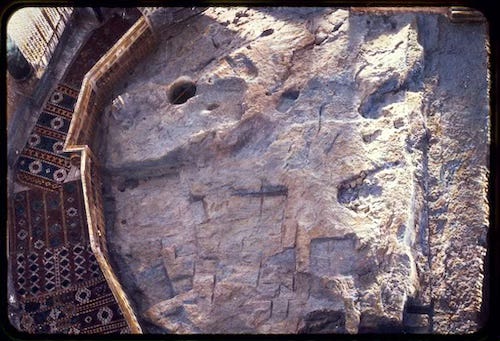
The image above is a photo of the “Foundation Stone” inside the Dome of the Rock in Jerusalem.
It is where Abraham bound Isaac.
It is the location of the threshing floor that David purchased from Araunah the Jebusite.
… specifically the Holy of Holies…
… specifically where the Ark of the Covenant rested and the Tabernacle was erected.
The location of the Temple later built by Solomon.
Jewish tradition calls it “the navel of the world,”1 the center of the created world, the axis of the world, and point of contact between heaven and earth.
(Don’t get distracted—too much—by the mechanics and practicalities of history and geography.)
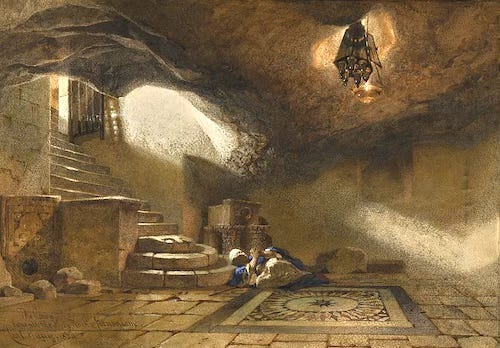
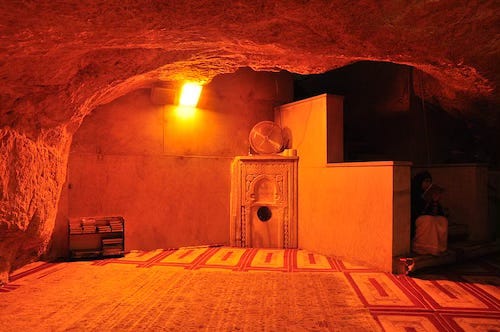
Beneath this stone is a cave—partly natural, partly hewn—a fortress-in-rock believed to have been a hiding place for the Ark:
Psalm 27:6 says:
For in the time of trouble he shall hide me in his tabernacle; indeed, in the secret place of his dwelling he shall hide me, and set me high upon a rock of stone.
When I read that verse, I’m convinced that David is thinking of a particular spot, that cave beneath where the Holy of Holies was located, atop Mt. Zion.
I believe that physical cave is “the secret place of [the LORD’s] dwelling” that David has in mind. And also the reason why occupying that spot is being “set high upon a rock of stone.” (Read more here. Pics here.)
To be sure, neither for David nor for us is the LORD limited to that space.
But that physical point of reference, in the Holy of Holies, symbolizes the invisible and eternal place in the heart of God for each of his own.
So…
Think of as many “rock” or “stone” images in scripture as you can remember, with this actual, physical place in mind.
Pray:
“For in the time of trouble he shall hide me in his tabernacle.”
,
Coming soon!
Regency: The Meaning of Our Work: A Practical Symbology
The midrash Tanhuma (Roman era) says about this site::
As the navel is set in the centre of the human body, so is the land of Israel the navel of the world... situated in the centre of the world, and Jerusalem in the centre of the land of Israel, and the sanctuary in the centre of Jerusalem, and the holy place in the centre of the sanctuary, and the ark in the centre of the holy place, and the Foundation Stone before the holy place, because from it the world was founded.