The following talk was given at the Thursday Men’s Breakfast. Audio here.
Why work? Why should we work?
If you were to search online, you might find that website that poses this as a rhetorical question: “Why work?” They don’t see much reason.
Many ancient Greeks had an adjacent attitude:
Work is the purview of slaves, and women.
Men of noble character have the leisure to free the mind to contemplate the highest things.
Work is ignoble.
We see something like these attitudes in the recent phenomenon of “quiet quitting,” in which you do as little work as possible to still get paid. Do the minimum.
Today, those attitudes are often a reaction to obsessive work, the opposite extreme, seeing work as the measure of our worth—ironically, this can be found in some corners of capitalism as well as in Marxism. Why work?
Because work defines us.
Because what we produce is the final statement of who we are.
I find my purpose in professional success.
My life has meaning because I do work that "counts" in the eyes of others.
Among most of our peers, that attitude is rarely explicit, or even conscious.
But it is a reality, for some of us.
Why work? Between the extremes, we see various instrumental answers:
We work to pay the bills.
We work to provide.
We work for the weekend.
Why work? Most Christians, if asked to give a "spiritual" answer, might add other instrument reasons:
To give money to God's work.
To gain a platform for sharing the gospel with others.
Not quite instrumentally: I should work to live for God, and as an example of Christian life, just as I should do anywhere.
Those Christian answers are not bad, but they are incomplete.
It's not enough to be good Christians in our work, we need to have a better biblical framework on our work.
And that’s what we have in Genesis 1.
In the next few minutes, I want to draw your attention to some things in Genesis, the whole chapter, and then draw six conclusions.
We can only look at a few things. When I did my MDiv at Gordon-Conwell, I had “Theology of the Pentateuch.” And the running joke was that for this course, on the first five books of the Bible—”Pentateuch”—was that three quarters of the semester was devoted to the first three chapters of Genesis!
But the better explanation for the emphasis of the class is that these first few chapters of the book are not a warm-up. These introductory chapters are a Rosetta stone for understanding the rest of the Bible.
And especially this first chapter, it’s a gem with countless facets to see, in wonder and beauty and insight.
And we can only look at a few things today. But to get to the conclusions, we really do need to look at the whole chapter.
1 In the beginning God created the heavens and the earth.
Everything. God created it all.
2 Now the earth was formless and empty,
“Formless and empty” Tohu vah-vo-hu in Hebrew.
Topsy-turvy
Helter skelter
Pell mell
Tohu vah-vo-hu
… darkness was over the surface of the deep, and the Spirit of God was hovering over the waters.
It was formless and void.
God will now form it.
God will now fill it.
God will work it.
“Slicing and dicing,” we might say.
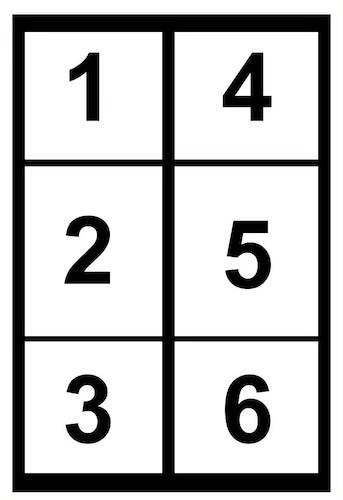
What we are going to see should be organized this way:
I want your participation. I will ask you to answer two questions:
What did God create on each day?
And: Why?
3 And God said, “Let there be light,” and there was light. 4 God saw that the light was good, and he separated the light from the darkness.
5 God called the light “day,” and the darkness he called “night.” And there was evening, and there was morning—the first day.
So what does God create on the first day?
The light is good.
The darkness is not.
6 And God said, “Let there be a vault between the waters to separate water from water.” 7 So God made the vault and separated the water under the vault from the water above it. And it was so. 8 God called the vault “sky.” And there was evening, and there was morning—the second day.
So what does God create on the second day?
Sky and water.
Sky and water? Not land and water? Not sky and land?
Hold that thought.
9 And God said, “Let the water under the sky be gathered to one place, and let dry ground appear.” And it was so. 10 God called the dry ground “land,” and the gathered waters he called “seas.” And God saw that it was good.
11 Then God said, “Let the land produce vegetation: seed-bearing plants and trees on the land that bear fruit with seed in it, according to their various kinds.” And it was so. 12 The land produced vegetation: plants bearing seed according to their kinds and trees bearing fruit with seed in it according to their kinds. And God saw that it was good. 13 And there was evening, and there was morning—the third day.
So what does God create on the third day?
Land and vegetation: trees and plants
14 And God said, “Let there be lights in the vault of the sky to separate the day from the night, and let them serve as signs to mark sacred times, and days and years, 15 and let them be lights in the vault of the sky to give light on the earth.” And it was so. 16 God made two great lights—the greater light to govern the day and the lesser light to govern the night. He also made the stars. 17 God set them in the vault of the sky to give light on the earth, 18 to govern the day and the night, and to separate light from darkness. And God saw that it was good. 19 And there was evening, and there was morning—the fourth day.
So what does God create on the fourth day?
Sun, moon, stars.
Why? This is our question, remember. Why?
“To govern.” “To rule over.”
So when God creates “the heavens and the earth,” does “heaven” refer to the natural, which we see, or to the supernatural, which we do not?
The answer of course is both.
But they are not separate in the way that we modern people think. What we see represents what we do not see: Outward and visible signs of inner and unseen realities. That’s how the Bible frames it, over and over.
20 And God said, “Let the water teem with living creatures, and let birds fly above the earth across the vault of the sky.” 21 So God created the great creatures of the sea and every living thing with which the water teems and that moves about in it, according to their kinds, and every winged bird according to its kind. And God saw that it was good. 22 God blessed them and said, “Be fruitful and increase in number and fill the water in the seas, and let the birds increase on the earth.” 23 And there was evening, and there was morning—the fifth day.
So what does God create on the fifth day?
Birds and fish. Aha! Note that these correspond to the second day!
24 And God said, “Let the land produce living creatures according to their kinds: the livestock, the creatures that move along the ground, and the wild animals, each according to its kind.” And it was so. 25 God made the wild animals according to their kinds, the livestock according to their kinds, and all the creatures that move along the ground according to their kinds. And God saw that it was good.
26 Then God said, “Let us make mankind in our image, in our likeness,
So what does God create on the sixth day?
Animals and a special kind of animal.
so that they may rule over the fish in the sea and the birds in the sky, over the livestock and all the wild animals, and over all the creatures that move along the ground.”
27 So God created mankind in his own image,
in the image of God he created them;
male and female he created them.
28 God blessed them and said to them, “Be fruitful and increase in number; fill the earth and subdue it. Rule over the fish in the sea and the birds in the sky and over every living creature that moves on the ground.”
And why does God create humankind?
29 Then God said, “I give you every seed-bearing plant on the face of the whole earth and every tree that has fruit with seed in it. They will be yours for food. 30 And to all the beasts of the earth and all the birds in the sky and all the creatures that move along the ground—everything that has the breath of life in it—I give every green plant for food.” And it was so.
31 God saw all that he had made, and it was very good. And there was evening, and there was morning—the sixth day.
Here’s our answer to the question, Why work? We were born to rule!
When you read the opening sections of Genesis, what issues come to mind? Evolution? The age of the Earth? Genesis is more about Who and Why than How or What. It is more about relationships than biology or geology. It is more about theology and your world view than about the natural sciences.
If we try to answer very many questions about science out of these chapters, we overlook the most important things that God is telling us.
The first observation we see is that . . .
1. God made us.
Throughout time there have been stories about how we got here. The Ancient Near Eastern religions that surrounded Israel said that the world was created by a great battle between gods and that the earth sprung from the torn body of the loser.
Or another neighbor said that the universe was the result of the sexual union of a male and female god.
Another said that creation resulted from the semen of a god.
In modern times, some people have answered the question by saying, "It just happened." How did we get here? Time plus matter plus chance. It just happened.
The Bible says God made us.
2. God made us for himself.
You didn't make yourself. You don't own yourself. God made you and he made you for himself. There is no such thing as a self-made man. No such thing as a self-made woman, in this sense or any other sense. Everything you have--brains, skill, experience, money, talent, savvy--God gave it to you.
The Apostle Paul asks, "What do you have that you didn't receive?" Nothing. You don't have a right to live this life as you please. God made you for himself.
3. God himself is a worker.
The verse after our text says that when God had completed all of this, he ceased from his work. Throughout the scriptures God portrays himself as Creator, gardener, advocate, composer, performer, builder, architect, captain, king, teacher, judge, servant, priest, physician, carpenter, and garment maker, to name just a few of his excellences. God is a worker. He created us as an act of work.
4. We are made in the image of God.
Throughout history, theologians have tried to define just what it is that constitutes our being made in the image of God.
Some say that it is our intellect, emotions, and will.
Others think that our personality is what it means to be made in God's image.
Still others point to our plurality in sexuality, that the two sexes show something of God's nature.
Some point to the original moral purity of humankind. All these have some truth no doubt.
In general "the image of God" refers to our reflectiveness and representation. We reflect and represent who God is. The message of the Bible as a whole is that we are meant to point to God, to show the world something of his image.
But in this text, specifically, the author is pointing to something else. It is that . . .
5. Ruling over this earth is part of what it means to be made in God's image.
This whole text leads to a conclusion: we were born to rule. We were created to rule, not over each other, but over the creation. We are his stewards over this world.
God has given us a share in his sovereignty over creation. You just saw it in the way the whole creation is laid out. The structure of creation demonstrates God's ordering of this creation.
In the first three days, God creates three realms or kingdoms: light and dark, water and sky, land and plants. You can't have realms without rulers. So where are the rulers?
Days 4, 5, and 6.
And to top it all off, "Then God said, 'Let us make man in our image, in our likeness, and let them RULE OVER the fish of the sea and the birds of the air, over the livestock, over all the earth, and over all the creatures that move along the ground." God even has Adam name the creatures, showing his rulership over them. God has given us a share in his sovereignty over creation.
What sends us to work each day? Why work? We come now to the answer to the question. It’s because...
6. God has a province for you to oversee in his kingdom.
You are not working for a paycheck. You are not working for a boss, first of all. You work for the Great King and he has appointed you a prince somewhere in his domain.
Ephesians 6:6 tells us how to work: "Obey your earthly masters with respect and fear, and with sincerity of heart, just as you would obey Christ. Obey them not only to win their favor when their eye is on you, but like slaves of Christ, doing the will of God from your heart. Serve wholeheartedly, as if you were serving the Lord, not men, because you know that the Lord will reward everyone for whatever good he does, ....
You were born to rule. He has a job for you. You are on a mission from God. You are destined for the throne.
God has a province for you to oversee in his kingdom.
You may be saying, "Kelly, I don't feel like the prince of anything. You don't know what my job is like." But this appointment, this province, is not just your job, it's your whole life: your life's work for God. Nobody else can fill the role. Nobody else has your preparation, experience, talents, passions, desires. You are his representative in your work--paid work and unpaid work.
If you do a good job where you are, with what you have, your sphere of influence will increase, both in this life and in the next. "For whoever has, to him shall more be given; and whoever does not have, even what he has shall be taken away from him." (Mark 4:25) "He who is faithful in a very little thing is faithful also in much; and he who is unrighteous in a very little thing is unrighteous also in much. (Luke 16:10)
God has a province for you to oversee in his kingdom. This is the story of our existence. Fill your minds with it.
God has a province for you to oversee in his kingdom.
Psalm 8
1 Lord, our Lord, how majestic is your name in all the earth!
You have set your glory
in the heavens.
2 Through the praise of children and infants
you have established a stronghold against your enemies,
to silence the foe and the avenger.
3 When I consider your heavens,
the work of your fingers,
the moon and the stars,
which you have set in place,
4 what is mankind that you are mindful of them,
human beings that you care for them?
5 You have made them a little lower than the angels[e]
and crowned them with glory and honor.
6 You made them rulers over the works of your hands;
Excellent! Though many people are uncomfortable with hierarchy and ruling per se, the fact is hierarchy is unavoidable in this world. Many do not know how to rule properly.



Excellent! Though many people are uncomfortable with hierarchy and ruling per se, the fact is hierarchy is unavoidable in this world. Many do not know how to rule properly.