

2 Samuel 20
September 2, Year 1
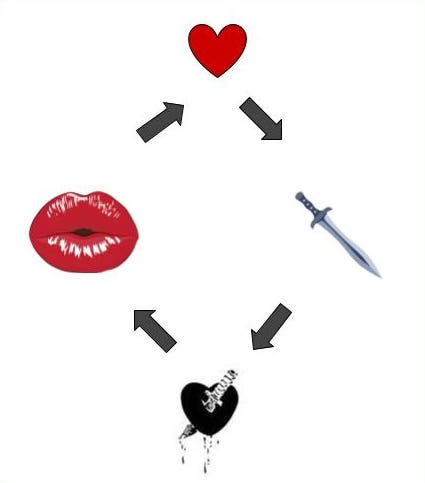
[8-10] When they were at the great stone that is in Gibeon, Amasa came to meet them. Now Joab was wearing a soldier’s garment, and over it was a belt with a sword in its sheath fastened on his thigh, and as he went forward it fell out. And Joab said to Amasa, “Is it well with you, my brother?” And Joab took Amasa by the beard with his right hand to kiss him. But Amasa did not observe the sword that was in Joab’s [left] hand. So Joab struck him with it in the stomach and spilled his entrails to the ground without striking a second blow, and he died.
This is a perfect example of the symbolism of the right and left hands—in perspective, from a point of view.
Before getting to the symbolism, here’s what happened:
Joab is a master warrior—a killer’s killer.
Dexterity with weapons is a perennial ambition of the fighter.
You can find countless online videos of expert swordsmanship—even today!
So contrary to some commentary on this passage, do not doubt: Joab planned this in advance.
He carries a sword/dagger rigged to fall from its scabbard at will.
It looks like an accident; it is not.
Now, on to the symbolism:
Think of the great stone as center, heart.
The symbolism of right and left is always from a perspective:
Whose right? Whose left?
It takes children quite a long time to learn.
Adults no longer even think about it.
We no longer think, either, that we don’t see ourselves in the mirror, but a mirror image of ourselves, the image of a person whose right and left are reversed.
Joab greets Amasa affectionately, and kisses him, taking hold of his beard with his right hand:
Embrace
Favor
Grace
Acceptance
Concentric—towards center/heart/unity
But in the same moment, the weapon drops from his belt into his hand without the motion of drawing the blade—his other hand, his left hand.1
The left is not usually the strongest, most-obvious hand to attack—one of the reasons we shake hands with the right.
But fighters take pride in ambidexterity. (See 1 Chronicles 12:2 and the example here.)
Joab avoids the other soldier’s wariness to strike Amasa, just one lethal blow!—with the left hand.
Judgment
Rejection
Revenge
Death
Excentric—away from center/heart/unity
All this is reversed from the perspective of Amasa.
Joab’s right is Amasa’s left, and his left is Amasa’s right.
Typically, right hand embraces right hand, crossing/inverting, between the two.
But the embrace from Joab’s right is actually from Amasa’s left, a betrayal, a Judas kiss.
And what is received on Amasa’s right is Joab’s (unexpected) left, the blade.
Rather than right receiving right, right receives left, and left receives (false) right.
Or to put it more simply, Joab just does the unconventional, just takes advantage of traditional meaning, to kill, rather than to embrace. He exploits the necessity of perspective.2
Or, the weapon falls to the ground, in an apparent accident, and Joab retrieves it, in a natural movement apparently recovering from clumsiness.
Furthermore, I don’t think we can avoid symbolically taking a perspective ourselves as we interpret the symbolism: Was Joab in the right?