

Psalm 144
The peril of the sword
Read/pray the psalm. (Full text at bottom.)
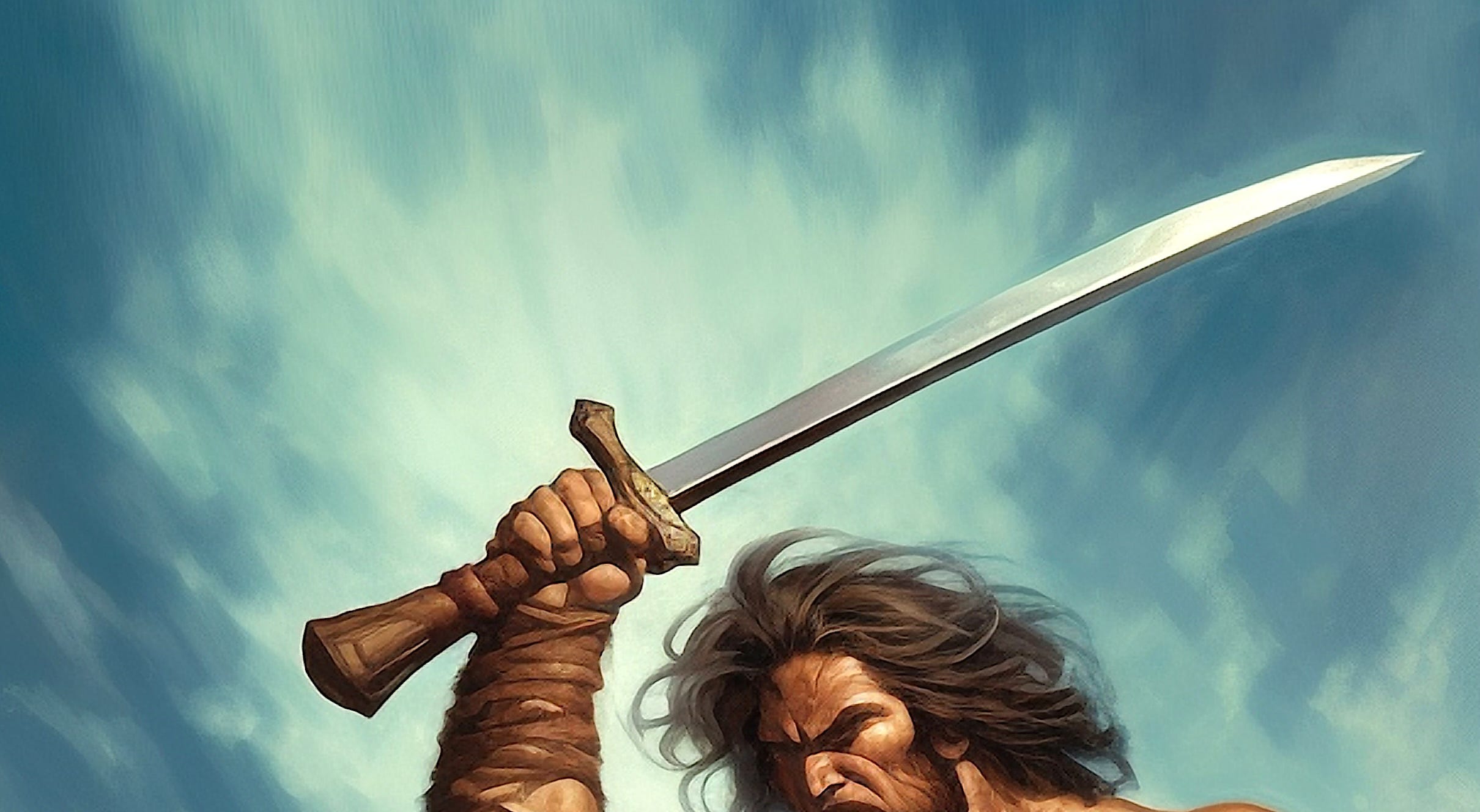
10 You have given victory to kings,
and have delivered David your servant from the peril of the sword.
Is there any verse in this psalm without a symbol that we have discussed in this space, several times? It’s overflowing with symbolic meaning.
But let’s return to the sword, before the grand finale of praise in Psalms 145-150.
Of the “simple machines,” the wedge is often considered the most fundamental, and prerequisite to the others.
It is a point, distributed.
“Keeping and cultivating the garden” supposes a wedge, a sharpened tool of some kind:
for digging (plowing)
for cutting (pruning)
(Even digging with hands, or breaking a branch, say, at a specific point, supposes this mechanical principle.)
But when humankind falls, tools become weapons.
We get thorns—the ground itself rebelling against the rebels, tiny swords fighting back.
And God places the cherubim to guard the entrance with a sword, the first mention of this weapon.
Once again, the interpretation of the symbol depends on where we stand in relationship to God:
We know the vision of “swords to plowshares, spears to pruning hooks.”
But with sin, note, the reverse can happen also! “Beat your plowshares into swords, and your pruning hooks into spears….” [Joel 3:10]
Sadly, in this fallen world, war is common.
May we never provoke it!
And if we must go to war, may we align always with God’s purposes, and means, in conducting it!1
(There is so much more on every point so far.)
So…
Look at your dominant hand, usually our “right hand,” mentioned in the psalm—your primary gardening hand, and your sword hand.
Pray:
Teach my hands and fingers, "that our storehouses may be full and plenteous with all manner of grain...." [13]
But if we must, "teach my hands to war and my fingers to fight...." [1]
Psalm 144
Benedictus Dominus

1	Blessed be the Lord my strength, *
		who teaches my hands to war and my fingers to fight,
2	My hope and my fortress, my stronghold and deliverer, my defender in whom I trust, *
		who subdues the peoples under me.
3	O Lord, what is man, that you have shown such respect to him, *
		or the son of man, that you so regard him?
4	Man is like a thing of nought; *
		his time passes away like a shadow.
5	Bow your heavens, O Lord, and come down; *
		touch the mountains, and they shall smoke.
6	Cast forth your lightning and scatter them; *
		shoot out your arrows and consume them.
7	Send down your hand from above; *
		deliver me, and take me out of the great waters, from the hand of strangers,
8	Whose mouth talks of vain things, *
		and whose right hand is a right hand of falsehood.
9	I will sing a new song unto you, O God, *
		and sing praises unto you upon a ten-stringed lute.
10	You have given victory to kings, *
		and have delivered David your servant from the peril of the sword.
11	Save me, and deliver me from the hand of strangers, *
		whose mouth talks of vain things, and whose right hand is a right hand of falsehood;
12	That our sons may grow up as young plants, *
		and that our daughters may be as the polished corners of the temple,
13	That our storehouses may be full and plenteous with all manner of grain, *
		that our sheep may bring forth thousands and ten thousands in our fields,
14	That our oxen may be strong to labor, that there be no decay, *
		no leading into captivity, and no outcry in our streets.
15	Happy are the people of whom this is so; *
		indeed, blessed are the people who have the Lord for their God.

New Coverdale Psalter
The most important biblical text concerning “just war theory” is Romans 13:1-7.
The most foundational texts of theology are:
Augustine, The City of God, Book 19, Chapters 7, 12-15
Thomas Aquinas, Summa Theologica II-II Question 40, Article 1