

Ruth 1
July 6, Year 1
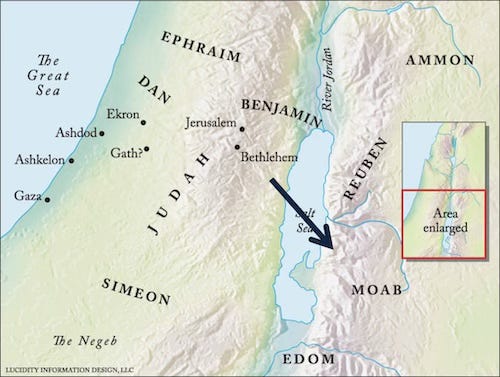
[1] In the days when the judges ruled there was a famine in the land, and a man of Bethlehem in Judah went to sojourn in the country of Moab, he and his wife and his two sons.
Skipped in the lectionary: Judges 17 18 19 20 21
Ruth is a story about “seed”—as symbol, not mere metaphor.
Famine drives this family into exile: They “sojourn” in Moab for food, leaving Bethlehem (“house of bread”).
Death seems to end their lineage.
But God has not forgotten the seed promised to Eve.
Moab is on the margin—literally, geographically outside the borders of Israel.
The Moabites are descendants of Lot.
Moab is born to Lot by his oldest daughter, who rapes her father after getting him drunk.
But in Ruth, Moab is redeemed.
Ruth is “the stranger”—the sojourner, the foreigner, the alien—brought into the house of Israel so completely that she becomes a forebear of Messiah.
Naomi (with her dead husband and sons) is Israel.
The LORD has embraced Naomi’s daughters-in-law via their marriage to her sons.
But after the tragedy of their deaths, they do not respond alike:
Orpah returns to her people.
While she does no wrong in leaving Naomi, per se, her decision has far greater implications than just that relationship.
Naomi is Israel. Orpah chooses Moab, and by extension, their gods, especially Chemosh.1
Some Jewish traditions supply an epilogue for Orpah, whether true or moralizing legend:
Orpah’s name is interpreted according to the word oref, meaning she “turned her back to her mother-in-law.
In the Babylonian Talmud (compiled c. 500 AD), Sotah 42b, Orpah supposedly falls into promiscuity of the vilest sort.
She is explicitly identified with Harafah (or Raphah), the mother of four Philistine giants, one of whom is Goliath (based on 2 Samuel 21:18–22).
But Ruth “clings” to Naomi.
“And the name of the second was Ruth [Rut],” because she saw [ra’ata] truth in the words of her mother-in-law.” Ruth Rabbah 2:9
All she has of Israel and of the LORD is Naomi; she embraces them in her.
She will be the forebear of David.
Together they return to Bethlehem (“house of bread”) at the beginning of the barley harvest.
Chemosh is mentioned in Numbers 21:29 and 1 Kings 11:7. He demands practices like human sacrifice (e.g., 2 Kings 3:27, where the Moabite king sacrifices his son during a battle).